Nanonets tells you to check every row against the PDF. A bank statement already prints the answer.
The best Nanonets alternative for bank statements is one that checks its own work against the balances printed on the statement, so you don't have to compare rows with the PDF by eye. ZeraBooks does that on every statement, per account, and only marks it proven when it ties to the cent. I founded ZeraBooks; the Nanonets facts below are from Nanonets' own pages, read on November 5, 2026.
What does Nanonets say to do after it converts a statement?
Nanonets' bank statement converter page claims "99%+ accuracy" without saying how that's measured. Each extracted transaction links back to its spot on the statement, which they call "Verify with source links". Exports are XLSX, CSV and JSON.
Then the FAQ says the quiet part. Review and validate the data by comparing the rows against the original PDF. It calls that step crucial.
I agree it's crucial. I just don't think a person should be doing it row by row.
Why is the statement's own balance a better check than your eyes?
Because the bank already did the math. Every statement prints an opening balance and a closing balance, and most print a running balance too. If opening plus every row equals closing, nothing was dropped, doubled or flipped. If it doesn't, the gap usually tells you which row:
| The gap is | Usually means |
|---|---|
| Twice one row's amount | That row's sign is flipped |
| Exactly one row's amount | That row is missing or doubled |
| One of the printed totals | A subtotal was read as a transaction |
| A small multiple of 9 | Two digits are swapped |
A person comparing 300 rows with a PDF will miss things. Arithmetic won't. Nanonets' page doesn't mention a check against printed balances, so as far as I can tell from what it publishes, that's still on you.
What does that look like in ZeraBooks?
Three statements from three banks in our test set (Wells Fargo, Monzo and Navy Federal samples), each proven against its own printed balances, then downloaded as one file:
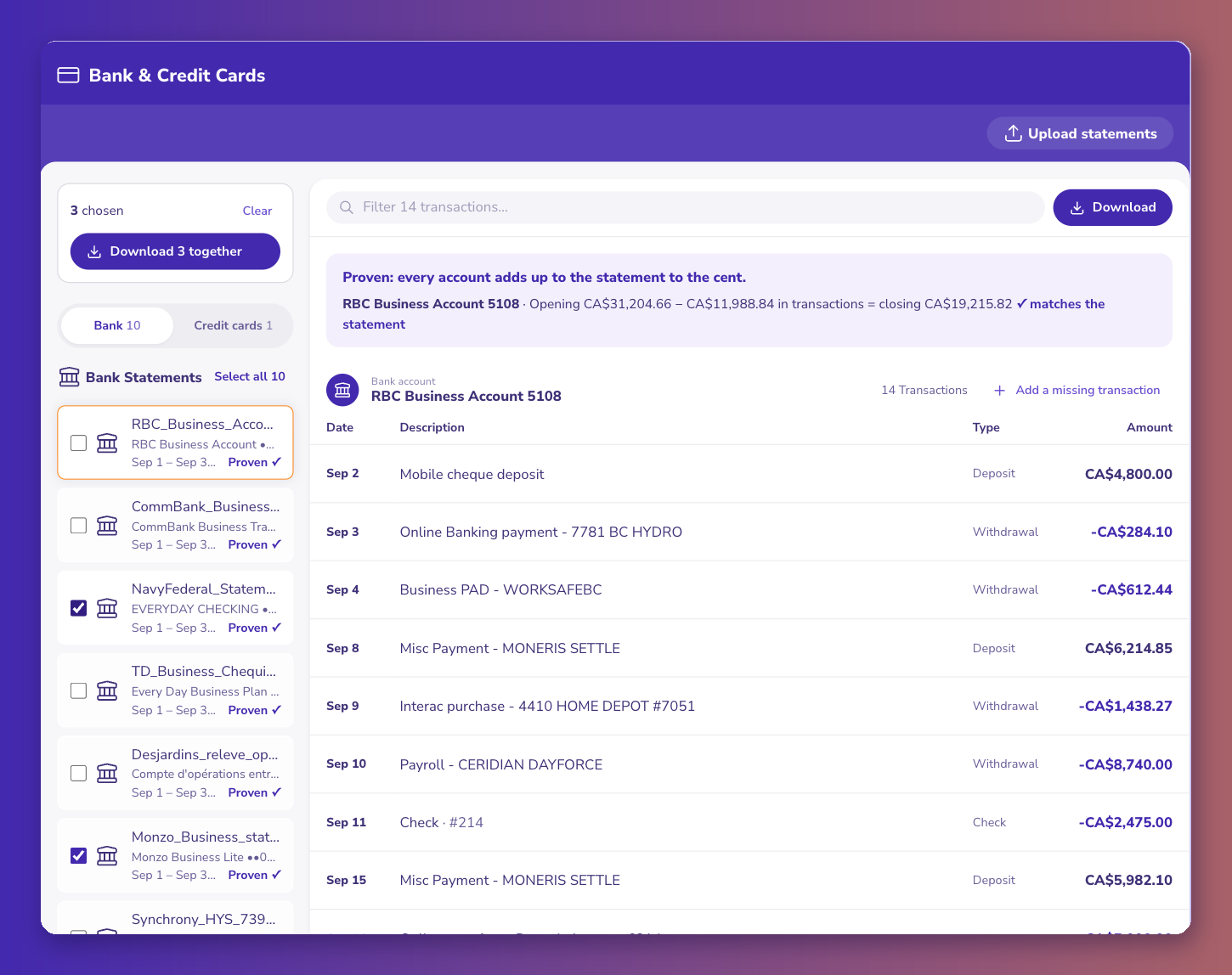
The Navy Federal one has two accounts in one PDF. Each account gets its own proof.
What does it cost?
Nanonets prices in credits on an AI workflow platform. Starter comes with $50 in credits, then $100 a month for 100 credits. Block runs cost $0.02 (simple), $0.10 (standard AI) or $0.30 (complex AI, which is where data extraction sits). The pricing page doesn't publish a price per page or per bank statement, so I can't tell you what a statement costs there.
ZeraBooks is priced per page: 1,000 pages a month for $79 billed annually or $149 monthly, with a 7-day trial. That's the number you put in an engagement letter.
The full comparison is on our Nanonets alternative page.
If a tool tells you to double-check its work, ask why it didn't.


Comments
Post a Comment